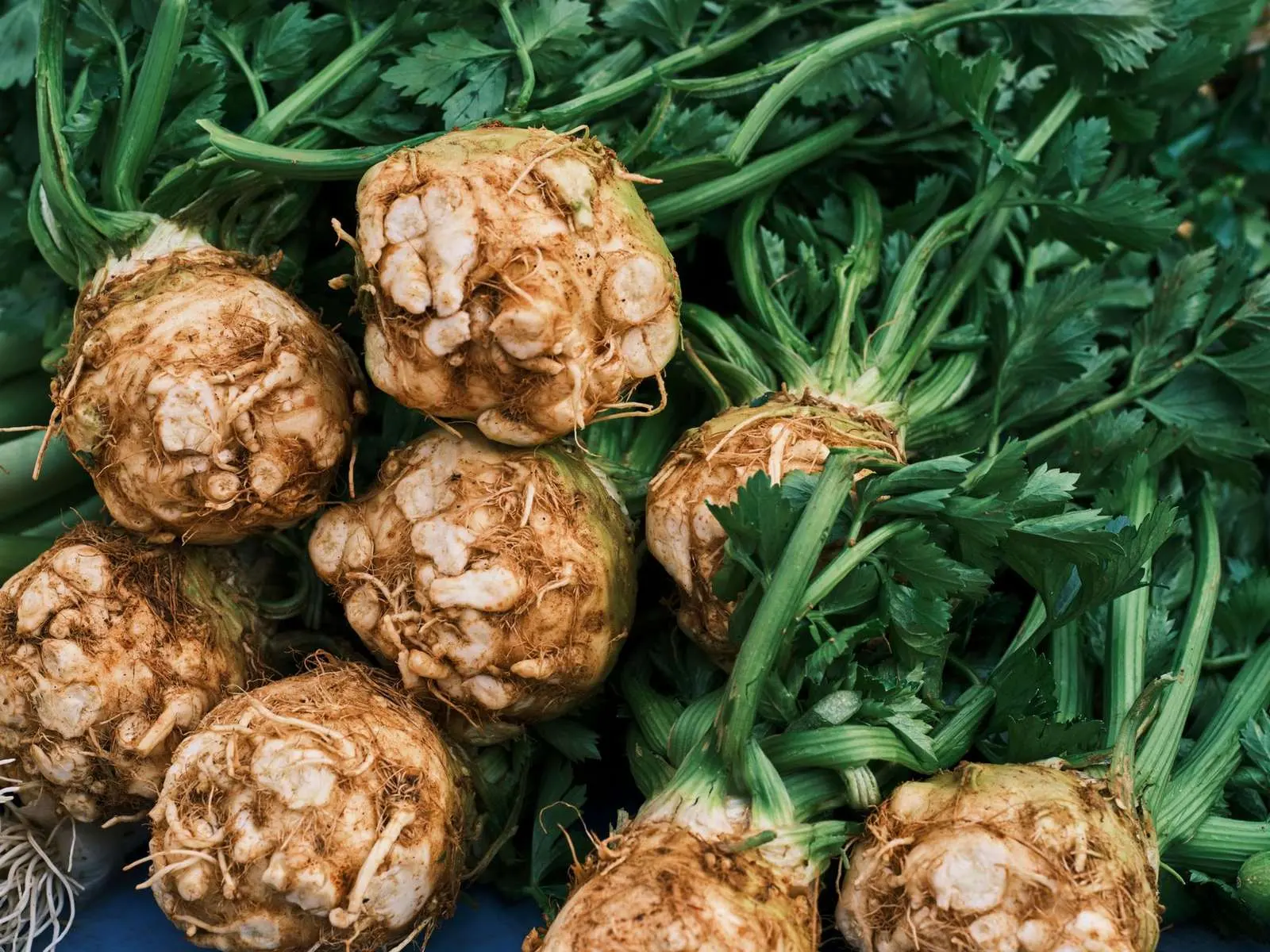
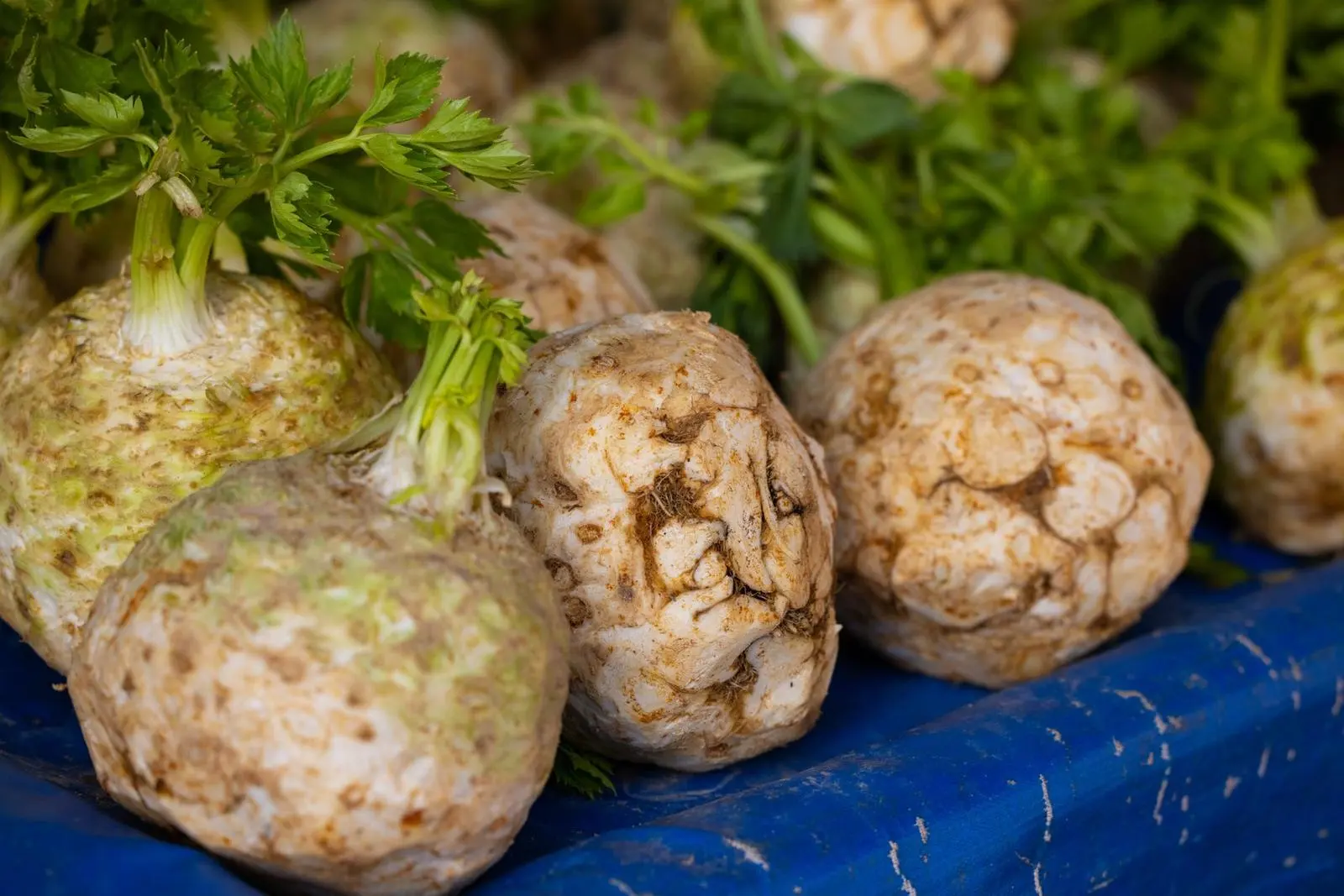
Staring at a hairy, knobby root and wondering what is celeriac? You are looking at the swollen root of a close celery relative, with a nutty, herbal flavour and just a hint of celery.
For more produce that suits the cold months, browse the seasonal vegetables section.
| Item | Value |
|---|---|
| Botanical name | Apium graveolens var. rapaceum |
| Typical diameter | 4-5 inches (10-13 cm) |
| Peak season | September to April |
| Keeping time, whole and unpeeled | A few weeks |
| Raw energy | Around 65 calories per cup |
These figures come from FoodPrint and Healthline. They can change, so check the sources before you rely on them.
What celeriac is and where it comes from
Celeriac (Apium graveolens var. rapaceum) is a swollen, knobby root covered in wiry rootlets, and FoodPrint says it looks more like a flower bulb than food. Cut away the hairy skin and the flesh is yellow-beige, less starchy than a potato but not as watery as jicama.
Despite a popular belief, celery root is not the root of the stalk celery sold in shops; it belongs to a close relative, and both descend from wild celery native to the Mediterranean, according to FoodPrint. Wikipedia adds that the species was bred over centuries into three primary cultivar groups: stalk celery, leaf celery and celeriac, the last grown for its large, edible hypocotyl.
Shops and recipes may also call it celery knob or turnip celery. Healthline lists turnip-rooted celery as another name.
Celery root reached the U.S. in the 19th century but never became mainstream, while it has long been much better known in Europe, Western Asia and North Africa, as FoodPrint notes.
As for taste, FoodPrint describes a balance of herbal, floral, nutty and fatty notes with just a hint of celery. Healthline compares the flavour to the upper part of the celery stem.
How do you choose a good celeriac?
FoodPrint boils the buying advice down to three checks:
- A firm root with no soft spots and a tangible heft.
- A smoother exterior, which will be easier to peel.
- A size closer to an apple or grapefruit than a cantaloupe, because the flesh of a very large root may be too woody.
For scale, Healthline gives a typical diameter of 4-5 inches (10-13 cm). A root in that range is usually the one to reach for.
When celeriac is in season
Healthline gives a peak season of September to April, though celeriac is generally available year-round. FoodPrint says it turns up through fall, winter and early spring and is at its best in the coldest months.
Large-scale growing is limited in the U.S.: the root was not included in the USDA’s 2017 Census of Agriculture, the most current at the time FoodPrint wrote its entry. You may spot it in a supermarket produce aisle, but a farmers’ market is the likelier place.
Gardeners planning cold-season beds can read about how to grow leeks. The page on winter vegetable garden what to plant helps with the rest of a winter plot.
Storing and peeling celeriac
Trim off any attached stalks and leaves before you store the root, advises FoodPrint. Then keep it in a root cellar if you have one, or in the crisper drawer, ideally wrapped in a kitchen towel or a paper bag.
Stored that way, a whole, unpeeled root will last a few weeks, according to FoodPrint.
When it is time to cook, FoodPrint says peeling and paring is usually best done with a sharp chef’s knife.
Ways to cook and serve celeriac
Celery root can be used raw, roasted or braised, says FoodPrint. Healthline adds that it is popular in Eastern and Northern Europe as a winter root, commonly used in salads, soups, casseroles and stews.
Some classic starting points from FoodPrint:
- Celeriac remoulade, a French slaw dressed with remoulade sauce.
- Soup, such as the recipe from Greek culinary authority Diane Kochilas, who adds fennel, figs and feta.
- A mash that blends the root with potatoes and garlic.
The mash is an easy first try, following the method in FoodPrint:
- Combine one part celery root with two parts potatoes and a few whole cloves of garlic.
- Boil with a half-teaspoon of salt per pound of vegetables until fork tender, about 25 minutes (FoodPrint).
- Strain, and keep some of the cooking liquid.
- Mash, ladling in the liquid as needed to loosen the texture.
- Season with butter, salt, black pepper and fresh parsley to taste.
Celeriac nutrition in brief
For cooked celeriac, the Norwegian food composition table Matvaretabellen lists 21 kcal in 100 g. That is the energy figure for the boiled vegetable, not the raw one.
For the raw root, FoodPrint says one cup contains around 65 calories and two to three grams each of fiber and protein, with mild amounts of calcium and potassium. It calls celery root far from a superfood, though it has some nutritional value.
Cooking method matters for vitamins. Healthline reports that boiling reduces the vitamin C content by at least 50%, and that steaming may prevent some of that loss.
Frequently asked questions
Is celeriac the same thing as celery root?
Show answer
Yes, the names are interchangeable. A label or recipe may say celery root, celery knob or turnip celery, but each points to the same swollen root.
Can you eat celeriac raw?
Show answer
Yes. Healthline describes raw celeriac as crunchy and well suited to salads and coleslaws, while cooking makes it slightly sweeter.
Does celeriac appear on the pesticide residue list?
Show answer
No. FoodPrint explains that celery root is left out of the Environmental Working Group’s Shopper’s Guide to Pesticides in Produce because it is not grown on a massive scale. Its suggestion for avoiding pesticides is to buy organic.
What can you do with the stalks and leaves?
Show answer
Rather than binning them, FoodPrint recommends saving the trimmings to flavour homemade stock.